

What services can children receive at home?
Pediatric home care is not one single service. Depending on a child's needs, care may include Private Duty Nursing, home health aide support, respiratory care, feeding support, therapy, mobility assistance, or Florida's Family Home Health Aide program.
What are pediatric home care services?
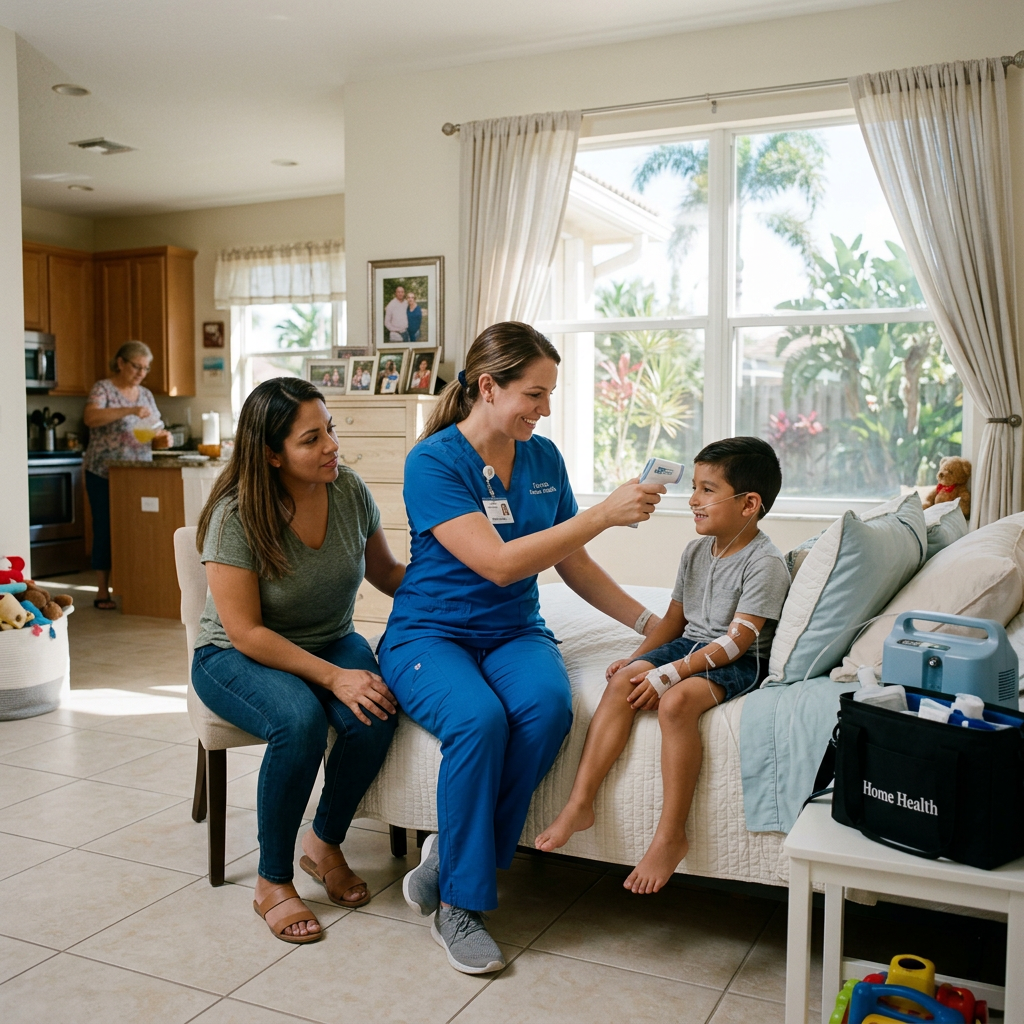
Pediatric home care services are health and support services provided in a child's home. Depending on the child's needs, services may include Private Duty Nursing from an RN or LPN, home health aide care, tracheostomy and ventilator support, feeding-tube care, therapy, personal care, mobility assistance, and Florida's Family Home Health Aide program.
The services a child actually receives depend on medical need, physician orders when required, clinical documentation, payer requirements, authorization, the approved plan of care, location, and availability of appropriately qualified staff.
Types of pediatric home care services
The term pediatric home care covers several different levels of support. Some services address daily routines and personal care. Others require a licensed nurse or therapist because the child has skilled clinical needs.
| Service | Who may provide it | What it may address |
|---|---|---|
| Pediatric Private Duty Nursing | Licensed RN or LPN | Ongoing skilled nursing, clinical monitoring, medication administration when ordered, feeding-tube care, seizure precautions, respiratory support, trach or ventilator care, and nursing documentation. |
| Home Health Aide | Appropriately qualified home health aide | Personal care, hygiene, mobility, transfers, positioning, daily routines, and other approved aide services. |
| Family Home Health Aide | Eligible trained family caregiver employed through a participating home health agency | Approved aide services for a child who meets Florida's FHHA requirements. |
| Trach and ventilator nursing | Qualified RN or LPN | Tracheostomy care, ventilator support, respiratory monitoring, suctioning when appropriate, equipment-related routines, and other skilled respiratory care included in the care plan. |
| Feeding and enteral support | Depends on the level of care required | Feeding routines, G-tube or enteral care, positioning, aspiration precautions, and related nutrition support when included in the care plan. |
| Physical therapy | Licensed therapy professional | Mobility, strength, positioning, balance, movement, and functional goals when therapy is clinically appropriate. |
| Occupational therapy | Licensed therapy professional | Daily living skills, coordination, adaptive routines, positioning, and functional participation. |
| Speech therapy | Licensed speech-language professional | Communication and swallowing-related needs when clinically appropriate and included in the treatment plan. |
Pediatric Private Duty Nursing
Private Duty Nursing, often called PDN, is skilled nursing provided by a licensed RN or LPN for a child whose medical needs require ongoing nursing support at home.
Depending on the child's condition and approved plan of care, pediatric PDN may include clinical observation, medication administration when ordered, feeding-tube care, tracheostomy care, ventilator support, seizure precautions, respiratory monitoring, and other skilled nursing tasks.
Learn more about pediatric Private Duty Nursing in Florida .
Home Health Aide support for children
A home health aide may help with approved personal care and daily routines that do not require the same level of clinical judgment as skilled nursing.
Depending on the child's plan of care and applicable requirements, aide support may include bathing, dressing, hygiene, mobility, transfers, positioning, and other authorized activities.
The exact tasks an aide can provide depend on the child's needs, care plan, applicable rules, agency policies, and payer requirements.
Florida's Family Home Health Aide program
Florida's Family Home Health Aide program allows an eligible family caregiver to become trained and employed through a participating home health agency to provide approved aide services for a child who meets the program requirements.
Current Florida Medicaid guidance requires the child to be under age 21, already receiving Private Duty Nursing, be under physician care, and have an order for FHHA services in the plan of care. FHHA and PDN are separate services and cannot simply be treated as interchangeable hours.
Approval and service hours depend on eligibility, physician orders, clinical documentation, authorization, the approved care plan, and other applicable program requirements.
Learn more about the Family Home Health Aide Program in Florida .
Trach, ventilator, and respiratory nursing
Children with tracheostomies, ventilators, oxygen needs, or other complex respiratory conditions may need skilled pediatric nursing at home.
Care may include tracheostomy routines, respiratory assessment, ventilator-related support, suctioning when appropriate, equipment monitoring, emergency preparedness, and other nursing tasks that are ordered, authorized, staffed, and included in the child's plan of care.
Explore pediatric trach and ventilator home care .
Feeding tube and nutrition-related support
Some children need support with G-tubes, enteral feeding routines, positioning, aspiration precautions, or other nutrition-related care.
The appropriate caregiver depends on how complex the child's feeding needs are and whether the task requires skilled nursing. Families should follow the child's clinical orders and care plan rather than assume every feeding-related task can be delegated in the same way.
Seizure and complex medication support
Children with seizure disorders or complex medication routines may need trained or skilled support depending on the child's clinical needs.
A care plan may address seizure precautions, observation, rescue-medication procedures when ordered, medication administration, documentation, and communication with the family and clinical team.
The level of care should match the child's medical needs and the professional scope required for the tasks involved.
Pediatric therapy at home
Some children may receive physical, occupational, or speech therapy at home when therapy is clinically appropriate and included in the treatment plan.
Movement and mobility
Physical therapy may address strength, balance, movement, positioning, mobility, and functional goals.
Daily living and function
Occupational therapy may address daily routines, coordination, positioning, adaptive activities, and participation in everyday tasks.
Communication and swallowing
Speech therapy may address communication or swallowing-related needs when clinically appropriate.
Therapy in a familiar setting
When home-based therapy is appropriate, treatment can be coordinated around the child's functional needs and care environment.
Explore in-home PT and OTPersonal care, mobility, and daily routine support
Some children need support with bathing, dressing, hygiene, transfers, positioning, mobility, or other activities throughout the day.
These needs may be related to a physical disability, developmental condition, medically fragile condition, or another health issue. The right caregiver depends on what tasks are required and whether any part of the routine involves skilled nursing.
Families looking for broader support can also review special needs home care .
Pediatric home care vs. Private Duty Nursing
Pediatric home care is the broader category. Private Duty Nursing is one specific pediatric home care service for children who need skilled nursing from an RN or LPN.
Pediatric home care
- Broad category of services provided to a child at home
- May include nursing, aide services, therapy, mobility support, and personal care
- The caregiver type depends on the child's needs
- Requirements vary by service and payer
Pediatric Private Duty Nursing
- Skilled nursing service within pediatric home care
- Provided by a licensed RN or LPN
- Used when the child requires ongoing clinical care
- Depends on physician orders, documentation, authorization, staffing, and the approved plan of care
How do parents know which service may fit?
Parents do not need to know the exact service name before asking for help. Start with what your child needs during a normal day and which tasks are difficult, time-sensitive, or clinical.
Does Florida Medicaid cover pediatric home care services?
Florida Medicaid may cover certain medically necessary pediatric home health services when the child meets the requirements for the specific benefit.
For Private Duty Nursing, current Florida Medicaid guidance applies to eligible recipients under age 21 who are under physician care, have an order for PDN in the plan of care, require more extensive and continual care than a home health visit can provide, and can safely receive the service at home or in the community.
FHHA has its own requirements. Coverage, authorized hours, documentation, service limits, and payer decisions should be confirmed with the child's Medicaid managed care plan, case manager, insurance provider, or other applicable payer.
A diagnosis or physician recommendation does not automatically guarantee approval, hours, staffing, or a start date.
How to start pediatric home care in Florida
Describe your child's needs
Share the child's diagnoses, medical equipment, feeding needs, respiratory needs, medications, mobility, recent hospitalizations, and the help currently needed at home.
Gather clinical documentation
Depending on the service, the agency or payer may need physician orders, medical records, discharge information, a plan of care, or other supporting documentation.
Identify the correct service
The child's needs will help determine whether the next step involves a nurse, home health aide, therapist, FHHA, or another form of support.
Review payer requirements
Medicaid managed care plans and insurance companies apply their own coverage, documentation, and authorization rules.
Confirm authorization and staffing
Services can begin only when the necessary requirements are met and appropriately qualified staff are available for the requested care.
Questions to ask a pediatric home care agency
Where Dynamiks provides pediatric home care
Dynamiks Home Care supports families across Florida. Service availability depends on the child's needs, location, requested service, payer requirements, authorization, documentation, and staffing.
View pediatric home care services in Florida or browse Dynamiks Home Care locations .
Pediatric home care services FAQs
What are pediatric home care services?
Pediatric home care services are health and support services provided to children at home. Depending on the child's needs, services may include Private Duty Nursing, home health aide care, FHHA, trach and ventilator nursing, feeding support, therapy, mobility assistance, and personal care.
What is the difference between pediatric home care and Private Duty Nursing?
Pediatric home care is the broader category of services delivered to children at home. Private Duty Nursing is one type of pediatric home care and is skilled nursing provided by a licensed RN or LPN for children who require ongoing clinical care.
What can a pediatric home health nurse do?
Depending on the child's needs and plan of care, a pediatric RN or LPN may provide clinical observation, medication administration when ordered, feeding-tube care, seizure precautions, respiratory monitoring, tracheostomy care, ventilator support, and other skilled nursing services.
Can pediatric home care include trach and ventilator care?
Yes. A child with a tracheostomy, ventilator, oxygen needs, or other complex respiratory needs may receive skilled nursing at home when the care is clinically appropriate, ordered when required, authorized, staffed, and included in the child's plan of care.
Can pediatric home care include physical or occupational therapy?
Pediatric home care may include physical, occupational, or speech therapy when therapy is clinically appropriate and included in the child's treatment plan.
What is the Family Home Health Aide program?
Florida's FHHA program allows an eligible family caregiver to become trained and employed through a participating home health agency to provide approved aide services for a child who meets the program requirements. Current Florida Medicaid guidance links FHHA eligibility to children who are already receiving Private Duty Nursing.
Does Florida Medicaid cover pediatric home care services?
Florida Medicaid may cover certain medically necessary pediatric home health services for eligible children. Each benefit has its own physician-order, documentation, eligibility, authorization, and coverage requirements.
How do I know which pediatric home care service my child needs?
Start with the child's daily and medical needs. The appropriate service may depend on whether the child needs skilled nursing, personal care, mobility support, respiratory care, feeding support, therapy, or another form of assistance. The child's physicians, care team, home health agency, and payer can help determine the appropriate next step.
How quickly can pediatric home care start?
There is no single start time. Services may depend on physician orders, clinical documentation, payer review, authorization, the type of care requested, location, and availability of appropriately qualified staff.
Florida sources
- Florida Agency for Health Care Administration: Private Duty Nursing and Family Home Health Aide Services
- Florida Administrative Code Rule 59G-4.261
This article is for general educational purposes. It does not determine a child's diagnosis, eligibility, Medicaid coverage, insurance benefits, authorized hours, staffing availability, or individual plan of care.
Dolores Fishbein, MSN, RN
Pediatric PDN, Complex Care, Medicaid & Family Education
Dolores Fishbein, MSN, RN, contributes to and reviews Dynamiks Home Care educational resources related to pediatric Private Duty Nursing, complex care, Medicaid, and family education. Her work helps families understand different levels of home care and prepare for conversations with physicians, care teams, home health agencies, and payers.
This guide explains the different types of pediatric home care services and how nursing, aide services, therapy, and family caregiver programs may fit into a child's care at home.
Not sure which pediatric home care service your child needs?
Tell Dynamiks Home Care about your child's current needs, medical equipment, physician recommendations, insurance or Medicaid information, and where care is needed. Our team can help you understand the next step and which pediatric service may be appropriate to discuss.
