

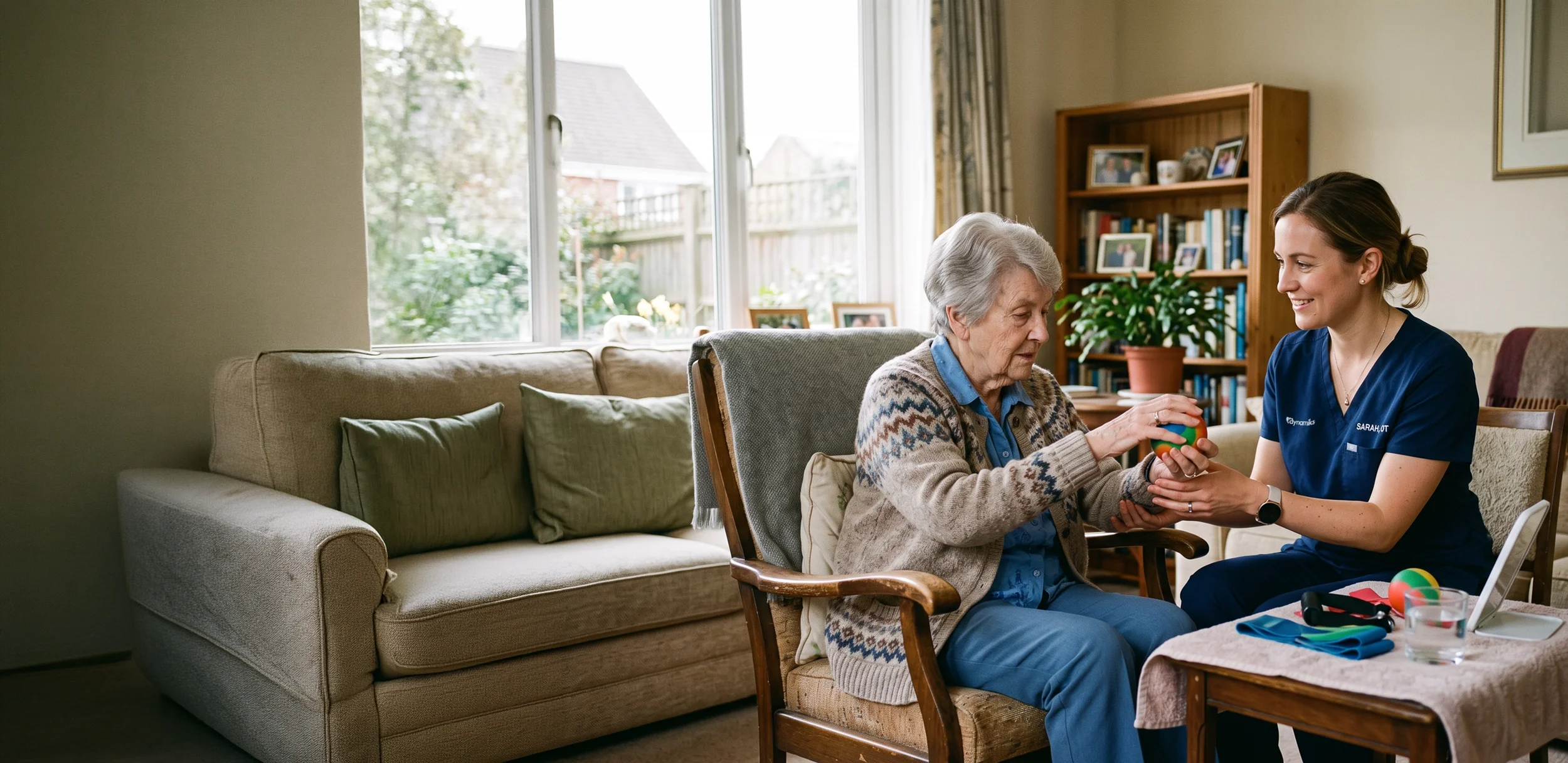
In-Home Occupational Therapy for Adults & Seniors in Florida
Occupational therapy at home helps adults and seniors work toward greater safety, independence, and participation in everyday activities where those activities actually happen. Depending on the person's needs and plan of care, therapy may address self-care, home routines, cognition, adaptive equipment, functional mobility, caregiver education, and home safety.
What is in-home occupational therapy?
In-home occupational therapy helps adults and seniors improve or maintain the skills needed for everyday life in the environment where those activities take place. Depending on the person's needs and approved plan of care, occupational therapy may address bathing, dressing, grooming, meal preparation, household routines, home safety, adaptive equipment, functional cognition, transfers, caregiver education, and strategies that support greater participation in daily activities. Service availability depends on clinical needs, applicable orders, payer requirements, authorization, location, therapist availability, and the approved plan of care.
What does an occupational therapist do in your home?
The home provides useful context for occupational therapy because the therapist can evaluate the real activities, routines, environments, and barriers affecting everyday function.
Evaluate everyday activities
The therapist may assess challenges involving bathing, dressing, grooming, toileting, meal preparation, household tasks, health management, and other meaningful activities.
Assess the home environment
An occupational therapist may evaluate bathrooms, bedrooms, kitchens, entrances, furniture placement, frequently used spaces, and other environmental factors that affect function or safety.
Recommend adaptive strategies
Therapy may include adaptive techniques, activity modification, environmental changes, or equipment recommendations when clinically appropriate.
Address functional cognition
When applicable, occupational therapy may address attention, memory, organization, sequencing, problem-solving, routines, and other cognitive skills as they relate to everyday activities.
Educate caregivers
Family members and caregivers may receive education about routines, environmental strategies, equipment, activity approaches, and ways to support the person's plan of care.
Who may benefit from occupational therapy at home?
In-home occupational therapy may be appropriate for adults and seniors whose illness, injury, surgery, hospitalization, neurological condition, physical limitation, cognitive change, or safety concern affects everyday activities.
Stroke recovery
Occupational therapy may address daily activities, upper-extremity function, adaptive strategies, functional cognition, routines, and participation after a stroke.
Parkinson's disease
OT may support daily routines, task modification, environmental strategies, functional cognition, and participation based on the person's individual needs.
Dementia or cognitive change
Occupational therapy may address routines, environmental cues, functional cognition, caregiver strategies, home safety, and meaningful daily activities.
Arthritis or physical limitations
Adaptive equipment, activity modification, energy-conservation strategies, and changes to daily routines may help support everyday function.
Recovery after hospitalization
OT may support a return to bathing, dressing, meal preparation, household tasks, transfers, routines, and other daily activities after illness or hospitalization.
Fall or home-safety concerns
An occupational therapist may assess environmental and functional barriers and recommend strategies or modifications that support safer participation at home.
Daily activities occupational therapy may address
The exact activities addressed depend on the person's goals, abilities, clinical needs, evaluation, applicable orders, and approved plan of care.
What happens during an in-home occupational therapy evaluation?
The evaluation helps identify how the person's current abilities, health condition, routines, home environment, and goals affect everyday function.
Discuss current challenges
The therapist may review recent health changes, functional concerns, daily routines, caregiver observations, and activities the person wants or needs to perform.
Observe functional performance
The therapist may observe how the person performs relevant everyday activities and identify physical, cognitive, environmental, or routine-related barriers.
Assess the home setup
When appropriate, the therapist may evaluate environmental factors that affect safety, efficiency, accessibility, or participation.
Develop the therapy plan
Goals, frequency, interventions, education, and recommended strategies are individualized according to the evaluation, applicable orders, payer requirements, and plan of care.
Occupational therapy vs physical therapy at home
Occupational therapy and physical therapy may overlap, but each discipline has a different primary focus. A person may receive both when clinically appropriate and included in the applicable plan of care.
Occupational Therapy
- Bathing and dressing
- Meal preparation
- Home management
- Adaptive equipment
- Functional cognition
- Daily routines
- Energy conservation
- Home-safety strategies
Physical Therapy
- Walking and gait
- Strength
- Balance
- Range of motion
- Transfers
- Physical mobility
- Movement mechanics
- Physical rehabilitation
Why receive occupational therapy at home?
Home-based therapy allows functional challenges to be evaluated in the actual environment where the person completes daily activities.
Real-world environment
Therapy can address the actual bathroom, kitchen, bedroom, entrances, furniture, routines, and equipment used every day.
Personally meaningful activities
Interventions can be connected to the tasks and routines that matter most to the individual.
Caregiver participation
Family members or caregivers may be able to participate in education and learn strategies relevant to daily routines.
Environmental problem-solving
The therapist can identify barriers and develop strategies around the person's actual home setup when clinically appropriate.
Insurance and coverage for in-home occupational therapy
Coverage for occupational therapy at home varies by payer, health plan, clinical need, applicable orders, medical necessity when required, authorization, network status, location, therapist availability, and approved plan of care.
Dynamiks Home Care can help families and referral sources understand what information may be needed to explore an available therapy pathway. Coverage, eligibility, a particular therapist, visit frequency, duration, or start date cannot be guaranteed.
Review Insurance InformationReal families. Real care. Real experiences.
Families share their experiences with Dynamiks Home Care across pediatric nursing, adult care, therapy, and home health aide support.
My family has been with this nursing company for over 5 years and have quality nurses working for them. The staff immediately answers questions, is in constant contact and inquires about the needs of my child. The nurses staffed for my son are the best and treat my child as their own family.
Everyone was very nice and helpful. I had at home PT after a total knee replacement. My therapist Shawn, who came regularly, was absolutely amazing. He helped me push and rebuild my strength quicker than I could’ve possibly imagined. Everyone has a great bedside manner. I highly recommend!
I love Dynamiks! I have had nothing but great experiences here with my son! The nurses are amazing and the owner of the agency is always available. This shows the dedication she has to her patients, and I am thankful to be a part of the Dynamiks family! I would give one thousand stars if I could!
It was really good that I have Dynamiks Home Care as my agency providing HHA services. Violette is a great caregiver, she helps me a lot, and she has more patience with me. I really love her as my HHA, she does everything for me.
In-home occupational therapy across Florida communities
Dynamiks Home Care serves adults, seniors, and families across multiple Florida communities. In-home occupational therapy availability varies by location, clinical needs, applicable orders, payer requirements, authorization, therapist availability, and the approved plan of care.
Insurance plans we work with
We work with a range of insurance and payer partners to help families explore home care coverage options for children, adults, and seniors across Florida.














In-home occupational therapy FAQs
Common questions adults, seniors, caregivers, and families ask about occupational therapy at home.
Can occupational therapy be done at home?
Yes. Occupational therapy may be provided in the home when clinically appropriate and applicable evaluation, order, payer, authorization, service-location, therapist-availability, and plan-of-care requirements are met.
What does an occupational therapist help with at home?
Occupational therapy may address bathing, dressing, grooming, meal preparation, household tasks, functional cognition, adaptive equipment, caregiver education, home safety, daily routines, and strategies that support participation in meaningful activities.
Who may benefit from in-home occupational therapy?
Adults and seniors whose illness, injury, surgery, hospitalization, neurological condition, physical limitation, cognitive change, or safety concern affects everyday activities may benefit when occupational therapy is clinically appropriate.
Can occupational therapy help after a stroke?
Occupational therapy may address daily activities, upper-extremity function, adaptive strategies, routines, cognition, caregiver education, and participation after a stroke depending on the person's individual needs and plan of care.
Can occupational therapy help someone with dementia?
Occupational therapy may address functional cognition, daily routines, environmental cues, caregiver strategies, home safety, activity modification, and participation in meaningful activities for some individuals experiencing cognitive changes.
Can occupational therapy help reduce fall risk at home?
An occupational therapist may identify functional or environmental barriers and recommend clinically appropriate strategies, equipment, activity modifications, or home changes that support safer participation in everyday activities.
What is the difference between occupational therapy and physical therapy?
Occupational therapy focuses heavily on participation in daily activities and routines, such as bathing, dressing, meal preparation, home management, adaptive equipment, and functional cognition. Physical therapy generally places greater emphasis on movement, walking, strength, balance, range of motion, and physical mobility. Some people may receive both disciplines when clinically appropriate.
Does Medicare cover occupational therapy at home?
Medicare may cover occupational therapy through the home health benefit when applicable eligibility and coverage requirements are met. Requirements may include being under the care of an eligible healthcare provider, having an established plan of care, meeting applicable homebound criteria, needing qualifying skilled services, and receiving services from an eligible home health provider. Coverage should be verified for the individual's specific situation.
How often will an occupational therapist visit?
Visit frequency and duration vary according to the person's evaluation, clinical and functional needs, applicable orders, payer requirements, authorization, progress, plan of care, location, and therapist availability.
How do I start occupational therapy at home?
Contact Dynamiks Home Care with information about the person's daily-living challenges, recent hospitalization or health changes, location, payer information, current healthcare providers, and any existing therapy orders or documentation. The team can help explain what steps may apply.
Talk with Dynamiks about
occupational therapy at home
Tell us about the person's daily-living challenges, recent hospitalization or health changes, mobility or cognitive concerns, location, payer information, and any existing therapy orders. Our team can help explain whether in-home occupational therapy may be an appropriate service to explore and what next steps may apply.