

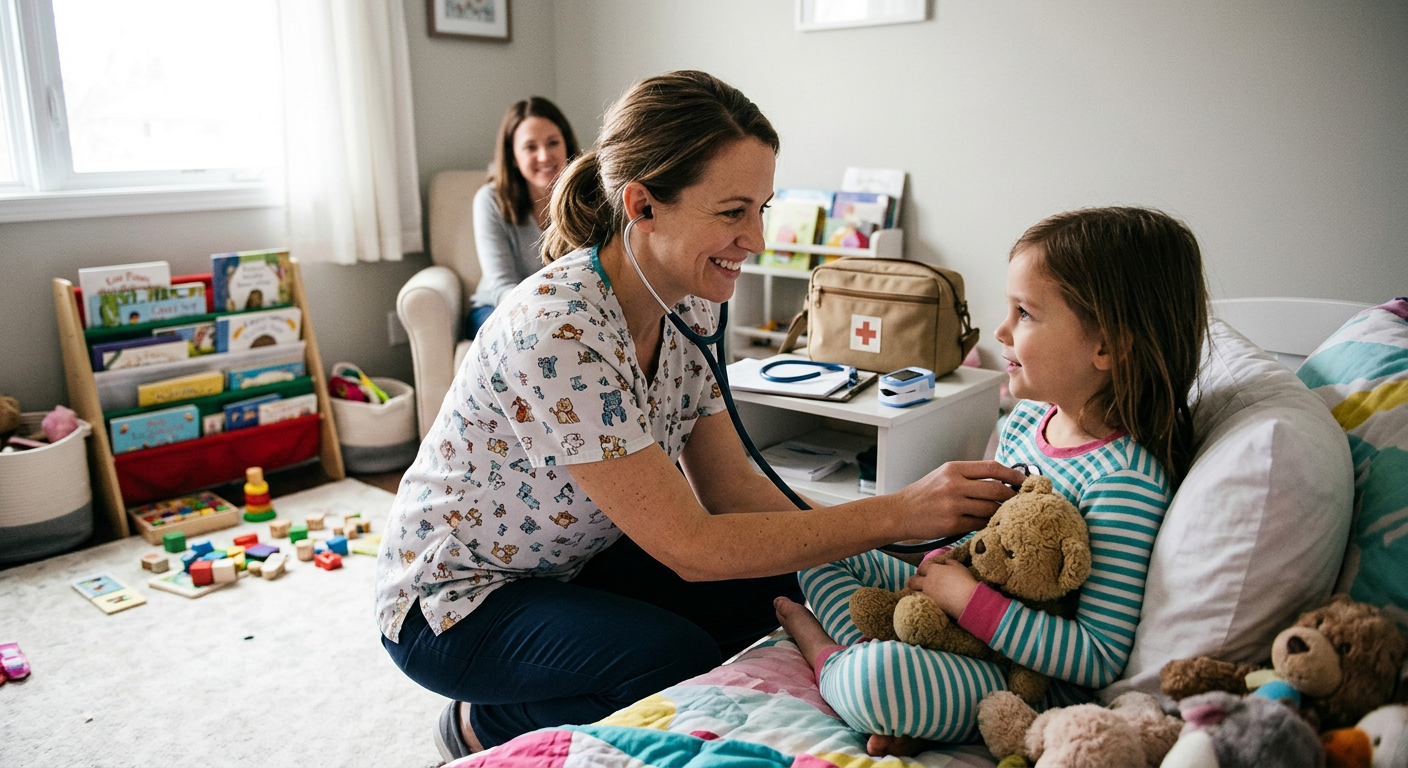
What is a pediatric home health nurse?
A pediatric home health nurse is a licensed Registered Nurse or Licensed Practical Nurse who provides skilled nursing for a child in the home when clinical care is needed. Depending on the child's needs and approved care plan, pediatric home nursing may include medication-related care, clinical monitoring, feeding tube support, tracheostomy or ventilator care, seizure-related precautions, respiratory care, medical equipment support, caregiver education, and coordination with physicians and other healthcare providers. Some children may receive this care through pediatric private duty nursing when clinically appropriate, ordered, authorized, staffed, and included in the approved plan of care.
Pediatric Nursing Care in the Home
Pediatric home nursing brings skilled clinical care into a child's everyday home environment. The nurse works within professional scope and the child's approved plan of care rather than replacing the child's pediatrician, specialist, therapist, or hospital team.
Some children need only intermittent skilled visits. Others may require one-on-one nursing for longer periods because their care involves medical technology, ongoing clinical monitoring, respiratory support, feeding routines, neurological conditions, medications, or other skilled nursing needs.
Families can also explore Dynamiks Home Care's broader pediatric home care services and pediatric private duty nursing .
What Does a Pediatric Home Health Nurse Do?
A pediatric nurse's daily responsibilities depend on the child's diagnosis, age, physician orders, equipment, medications, professional scope, nursing competency, payer authorization, and approved care plan.
Clinical Monitoring
Nurses may observe the child's condition, monitor ordered clinical indicators, document findings, and report meaningful changes according to the care plan.
Medication-Related Care
Nursing may include medication administration, monitoring, documentation, and other ordered medication-related services within professional scope.
Feeding Support
Skilled care may include G-tube or other enteral feeding routines, medications, monitoring, documentation, and caregiver education when appropriate.
Respiratory Care
Appropriately qualified nurses may provide tracheostomy care, suctioning, ventilator-related support, respiratory monitoring, and other ordered airway routines.
Seizure-Related Nursing
Care may include observation, safety precautions, ordered interventions, medication-related nursing, documentation, and communication with the child's care team.
Medical Equipment
Nurses may work with approved medical equipment when trained, competent, ordered, authorized, and included in the child's care plan.
Ordered Treatments
Pediatric nurses may carry out appropriate treatments and skilled routines that fall within professional scope and the approved plan.
Family Education
Nurses may help reinforce appropriate care routines, precautions, equipment use, documentation, and information about changes that should be reported.
Care Coordination
Nursing documentation and appropriate communication may help support coordination among families, physicians, specialists, therapists, case managers, and other care providers.
When Might a Child Need a Nurse at Home?
Families may explore pediatric home nursing when a child's clinical needs require skilled assessment, treatment, monitoring, or nursing procedures that should be provided by a licensed nurse or coordinated as part of an approved home care plan.
A child may need skilled support related to a tracheostomy, ventilator, suctioning, oxygen, respiratory monitoring, or other ordered airway care.
Children using feeding tubes or other enteral nutrition may need nursing routines, monitoring, medication-related care, or caregiver education.
Seizure disorders or other neurological conditions may require skilled observation, precautions, ordered interventions, and clinical documentation.
Some children need skilled support after discharge as families transition equipment, medications, feeding routines, respiratory care, and other clinical needs into the home.
Is Pediatric Home Nursing the Same as Private Duty Nursing?
The terms are related but are not always interchangeable. Pediatric home nursing is a broad description of skilled nursing delivered at home. Private duty nursing generally refers to more continual one-on-one RN or LPN care.
Pediatric Home Health Nursing
Pediatric home nursing may include skilled visits or other nursing arrangements based on the child's needs, physician orders, professional scope, payer requirements, authorization, and care plan.
Explore Pediatric Home CarePediatric Private Duty Nursing
Pediatric PDN generally involves one-on-one RN or LPN care for a child who requires more extensive and continual nursing than can be provided through intermittent home health visits.
Schedules may include daytime, overnight, or extended-hour nursing when clinically appropriate, ordered, authorized, staffed, and included in the approved care plan.
Explore Pediatric PDNRN vs. LPN in Pediatric Home Care
Both Registered Nurses and Licensed Practical Nurses may provide pediatric home nursing. The appropriate assignment depends on the child's clinical needs, professional scope, competency, physician orders, agency policies, payer authorization, and approved plan of care.
Registered Nurse
An RN may provide skilled assessment, clinical monitoring, treatments, medication-related care, care coordination, documentation, caregiver education, and other nursing services within professional scope and the child's approved care plan.
Licensed Practical Nurse
An LPN may provide ongoing skilled nursing within professional scope, competency, applicable supervision requirements, physician orders, authorization, agency policy, and the child's approved plan of care.
Complex Pediatric Nursing at Home
Some children need skilled nursing around respiratory care, nutrition, neurological conditions, medications, medical technology, or the transition home after hospitalization. Services should match the child's actual needs, physician orders, nursing competency, authorization, professional scope, staffing, and approved plan of care.
Trach & Ventilator Care
Skilled nursing may include appropriate tracheostomy routines, suctioning, ventilator-related support, airway observation, emergency planning, and documentation.
Feeding Tube Support
Care may include ordered feeding routines, enteral medications, monitoring, documentation, and caregiver education related to the child's feeding plan.
Seizure & Neurological Care
Nursing may include observation, precautions, ordered interventions, medication-related support, documentation, and communication with the healthcare team.
Post-NICU & Hospital Care
Home nursing may support approved clinical routines, equipment, medications, feeding, respiratory care, monitoring, and caregiver education after discharge.
Bringing Your Child Home After a NICU or Hospital Stay
Discharge home may involve new medications, feeding routines, respiratory equipment, medical supplies, follow-up appointments, therapy recommendations, nursing orders, and caregiver education.
When pediatric home nursing is being considered, beginning the referral and documentation process during discharge planning may help identify the services and staffing that will be needed. Actual start timing depends on applicable orders, documentation, authorization, care planning, location, scheduling, and qualified staff availability.
Does Florida Medicaid Cover Pediatric Private Duty Nursing?
Florida Medicaid may reimburse medically necessary pediatric private duty nursing for qualifying recipients when applicable requirements are met.
Current Florida Medicaid guidance describes PDN eligibility requirements that include:
- The recipient is under age 21.
- The child is under the care of a physician.
- A physician has ordered PDN services in the plan of care.
- The child's needs require more extensive and continual care than can be provided through a home health visit.
- The services can be safely provided in the home or community.
Florida Medicaid describes reimbursement of up to 24 hours of PDN per day, per qualifying recipient. “Up to” is a maximum benefit description and does not mean every eligible child receives 24 hours. Actual authorized hours depend on medical necessity, documentation, applicable payer requirements, authorization, and the approved plan of care.
Diagnosis or medical complexity alone does not guarantee eligibility, authorization, a specific number of nursing hours, a particular schedule, or a start date. Managed care requirements, documentation, medical necessity, staffing, and the approved plan of care may all affect services.
Can a Family Member Become a Family Home Health Aide?
Florida Medicaid's Family Home Health Aide benefit may allow an eligible family member or guardian to provide authorized FHHA services for a qualifying child when program requirements are met.
FHHA works alongside pediatric PDN rather than replacing all skilled nursing care. Authorized FHHA hours cannot duplicate authorized PDN hours.
Insurance & Pediatric Home Nursing Coverage
Coverage varies by payer and plan. Families should not assume a nursing service or number of hours is covered until the child's specific benefits and authorization requirements have been reviewed.
Medicaid & Managed Care
Medicaid managed care plans may require clinical documentation, physician orders, medical necessity review, prior authorization, provider requirements, and an approved care plan before covered nursing services can begin.
Private Insurance
Private plans may use different benefits, networks, authorization rules, documentation standards, cost-sharing arrangements, and covered nursing services. Coverage should be verified for the child's specific plan.
Families can review additional information on the Dynamiks insurance and coverage page .
How Pediatric Home Nursing Starts
The exact process varies by the child's clinical needs and payer. A specific start date should not be assumed until applicable assessment, documentation, authorization, care planning, and qualified staffing are in place.
Start the Conversation
Share the child's needs, location, current clinical concerns, equipment, and the schedule or services being explored.
Review Documentation
Applicable physician orders, clinical records, discharge information, payer details, and care requirements are reviewed.
Confirm Coverage
Applicable benefit requirements, prior authorization, documentation, and the approved plan of care are coordinated.
Coordinate Nursing
RN or LPN staffing and scheduling are coordinated based on approved services, competency needs, location, schedule, and staff availability.
Questions to Ask a Pediatric Home Care Agency
Families may benefit from asking how an agency evaluates clinical competency, communicates with the healthcare team, manages scheduling, and supports authorization requirements before care begins.
Looking for a Pediatric Home Health Nurse Near You in Florida?
Dynamiks Home Care serves multiple Florida areas. Pediatric nursing availability varies by the requested service, care needs, address, physician orders when applicable, payer requirements, authorization, competency needs, schedule, approved care plan, and qualified staff availability.
Pediatric Home Health Nurse Frequently Asked Questions
Answers to common family questions about pediatric nurses, private duty nursing, complex care, Medicaid, FHHA, insurance, overnight nursing, and starting care.
What is a pediatric home health nurse?
A pediatric home health nurse is a licensed RN or LPN who provides skilled nursing for a child in the home. Services vary according to the child's clinical needs, physician orders when required, professional scope, competency, payer requirements, authorization, staffing, and approved plan of care.
What does a pediatric home health nurse do?
Pediatric home nurses may provide clinical monitoring, medication-related care, treatments, feeding support, respiratory care, medical equipment support, seizure-related precautions, documentation, caregiver education, and care coordination when appropriate and included in the child's approved plan.
What is the difference between an RN and LPN in pediatric home care?
Both RNs and LPNs may provide pediatric home nursing, but their professional scope and responsibilities differ. The appropriate assignment depends on the child's needs, nursing competency, physician orders, payer authorization, agency policy, professional scope, and approved plan of care.
What is pediatric private duty nursing?
Pediatric private duty nursing generally refers to one-on-one RN or LPN care for a child who requires more extensive and continual skilled nursing than can be provided through intermittent home health visits.
Who may need pediatric home nursing?
Pediatric home nursing may be considered when a child's clinical needs require skilled assessment, monitoring, treatment, medical equipment support, feeding care, respiratory care, medication-related services, or other nursing procedures that should be provided by a licensed nurse.
Can pediatric nurses provide overnight care?
Pediatric PDN schedules may include daytime, overnight, or extended-hour nursing when clinically appropriate, ordered, authorized, staffed, and included in the approved plan of care. A particular schedule is not guaranteed until applicable requirements and staffing are confirmed.
Can a pediatric nurse care for a child with a trach or ventilator?
Appropriately qualified pediatric nurses may provide tracheostomy or ventilator-related care when the nurse has the required competency and the services are clinically appropriate, ordered, authorized, staffed, and included in the child's approved care plan.
Can a pediatric nurse provide feeding tube support?
Pediatric nursing may include G-tube or other enteral feeding routines, medication-related care, monitoring, documentation, and caregiver education when appropriate to the child's needs and approved plan.
Can pediatric home nursing help after a NICU or hospital stay?
Home nursing may support the transition after discharge through approved skilled nursing, equipment routines, feeding support, medication-related care, respiratory care, clinical monitoring, documentation, and caregiver education. Home nursing does not replace hospital or emergency care when facility-level treatment is medically necessary.
Does Florida Medicaid cover pediatric private duty nursing?
Florida Medicaid may reimburse medically necessary PDN for qualifying recipients under age 21 when applicable requirements are met. Current eligibility includes physician care, a PDN order in the plan of care, a need for more extensive and continual care than a home health visit provides, and the ability to safely receive services at home or in the community.
How many PDN hours can Florida Medicaid authorize?
Florida Medicaid describes reimbursement of up to 24 hours of PDN per day, per qualifying recipient. This is a maximum benefit description and not a guarantee of 24 hours. Actual authorized hours depend on applicable eligibility, medical necessity, documentation, authorization, and the approved plan of care.
What is Florida's Family Home Health Aide Program?
Florida Medicaid's FHHA benefit may allow an eligible family member or guardian to provide authorized family home health aide services for a qualifying child under age 21 who is receiving PDN and meets additional program requirements. Authorized FHHA hours may not duplicate authorized PDN hours.
Does private insurance cover pediatric home nursing?
Some private insurance and managed care plans may cover certain pediatric nursing services. Benefits, networks, prior authorization, documentation requirements, cost sharing, covered hours, and eligibility vary by plan.
How do I find a pediatric nurse near me?
Look for a licensed home care provider serving your address and ask whether the agency provides the specific level of pediatric nursing your child needs. Dynamiks Home Care serves multiple Florida areas, subject to care needs, authorization, location, scheduling, competency requirements, and staffing availability.
How do I start pediatric home nursing?
Contact Dynamiks Home Care to discuss your child's care needs, location, current orders or documentation, insurance or Medicaid information, equipment, and scheduling needs. Start timing varies based on assessments, physician orders when applicable, documentation, authorization, care planning, and qualified staff availability.
Related Pediatric Home Care Resources
Sources & Further Reading
Florida Agency for Health Care Administration: Private Duty Nursing Services and Family Home Health Aide eligibility
Florida Administrative Code: Rule 59G-4.261, Private Duty Nursing and Family Home Health Aide Services
Coverage, eligibility, authorized hours, documentation requirements, service availability, staffing, billing, and plan requirements may vary or change. Families should verify current requirements for the child's specific payer, approved care plan, and requested services.
Looking for a Pediatric Home Health Nurse?
Talk with Dynamiks Home Care about your child's nursing needs, current orders or documentation, Medicaid or insurance information, medical equipment, location, schedule, and the type of support your family is exploring.
